Getting started with ESG data collection without expertise: where do you begin?


More and more organisations are receiving requests for ESG (Environment, Social, Governance) data. Clients are integrating sustainability criteria into their supplier selection, banks are asking for additional information in financing processes, and internally there is growing recognition that structured reporting is not a temporary trend.
Yet in practice,things often stall at the very first step. Not because there is no willingness,but because there is no clear starting point. This is one of the most common situations companies face: they want to report, but do not know where to begin.
The reality today:intent is there, structure is missing
When an organisation decides to start with sustainability reporting, the same questions arise almost immediately:
· Which topics are relevant for us?
· How do we report in line with the VSME standard?
· Do we need to perform a full CO₂ calculation right away?
· What data do we already have?
· Who is responsible internally?
Without prior experience, the ESG landscape feels fragmented and technical. Frameworks use different terminology, reporting requirements seem complex, and the distinction between “nice to have” and “essential” is unclear.
As a result, many organisations start broadly and collect as much information as possible. Overtime, doubt sets in: are we focusing on the right areas? Will this be accepted by clients or banks? Have we overlooked something?
The biggest cost at this stage is not compliance - it is inefficiency. Time is spent on irrelevant topics, data is collected multiple times, and each reporting cycle feels like starting from scratch.
Why this becomes a structural issue
ESG reporting is not a one-off exercise. It requires a repeatable process. Yet the starting phase isoften approached in an ad hoc way, creating three key risks:
· Misaligned priorities: effort is spent on topics that are not relevant, while important areas remain underdeveloped
· Operational overload: finance or operations teams collect data manually without a clear framework
· Lack of reproducibility: there is no consistent structure to build on in future reporting cycles
Without a clear starting point, ESG is perceived as a complex project rather than a manageable process.
How ESGpro facilitates getting started
ESGpro is designed specifically for this phase: when an organisation wants to start ESG reporting without internal expertise.
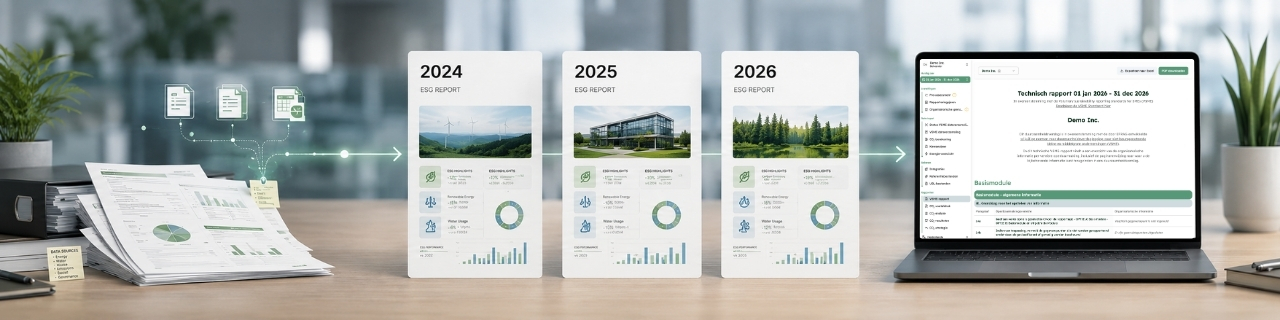
Instead of asking for data immediately, the platform begins with an automatic pre-assessment. Based on your sector, size and activities, ESGpro identifies which topics are relevant within the VSME structure.
The VSME standard serves as the starting point because it was specifically developed for SMEs and provides a structured framework for collecting ESG data in a consistent and reusable way.
In practice, this means:
· You gain clarity on which areas to prioritise
· Irrelevant topics are filtered out
· The reporting structure is automatically defined
· Data collection only starts once it is clear what is required
This shifts the focus from “collecting everything” to “working in a targeted way.”
What this means in practice
A structured starting point has immediate impact:
· Less time wasted on irrelevant topics
· Reduced reliance on external expertise in the early stages
· Lower risk of misinterpreting standards
· A consistent foundation for future reporting cycles
ESG reporting becomes not a one-time effort, but a process that is scalable and repeatable.
For organisations without an internal ESG specialist, this is often the difference between postponing and actually getting started.
From uncertainty to control
The first step in ESGreporting is rarely technical. It is organisational: knowing where to begin.
By defining direction upfront, you avoid turning reporting into a reactive exercise. You build afoundation that supports consistent progress year after year.
Who is this relevant for?
· Organisations that need to start ESG reporting but lack internal expertise
· Companies facing first requests from clients, banks or other stakeholders
· Finance, operations or management teams that need a clear and structured starting point
Ready to get started?
Create your ESGpro account today and take control of your ESG reporting process.

Schrijf u in voor onze gratis online introductie en ontdek hoe ESGpro duurzaamheidsrapportering eenvoudiger, betrouwbaarder en slimmer maakt. We tonen stap voor stap hoe het platform werkt, wat u wint, en beantwoorden uw vragen live.