ESG reporting across multiple entities: how do you keep it manageable?


ESG reporting becomes significantly more complex the moment it extends beyond a single entity.
What initially appears to be a structured reporting process quickly turns into a coordination challenge. Different teams collect data in their own way, definitions vary, and consolidation happens only at the end of the process.
The issue is not a lack of effort or data.
It is the absence of a system that supports consistency across the organisation.
This is a common situation in growing organisations: the intention is to report consistently across entities, but there is no system in place that supports this in a scalable way.
The reality today: every entity works differently
In organisations with multiple entities, ESG reporting rarely starts from a shared system.
In practice:
- different locations collect data in their own way
- definitions vary between entities
- spreadsheets circulate across teams
- consolidation happens late in the process
Finance or sustainability teams are left to bring everything together, often under time pressure.
As soon as a new entity joins the reporting process, the same issues reappear:
- existing templates need to be adapted
- Excel models are extended or duplicated
- formulas break or no longer work correctly
- calculations need to be rechecked
- historical consistency is lost
What worked for three entities no longer works for four. Repetition increases. The risk of errors grows. And each additional entity makes the system more fragile.
At that point, the underlying issue becomes clear:
- figures do not fully align
- assumptions differ between entities
- supporting evidence is difficult to trace
- consolidation becomes increasingly complex
The problem is not a lack of data. It's the absence of a scalable structure.
Why this becomes a growth constraint
As long as ESG reporting is limited in scope, inconsistencies remain manageable.
But as organisations expand - through new locations, acquisitions or international growth - the impact becomes more visible:
- No scalability: each additional entity increases complexity
- Higher error risk: reliance on manual adjustments and spreadsheets
- Lack of consistency: different definitions and approaches
- Time pressure at consolidation: reporting remains a peak workload
- Inefficiency: the amount of time invested becomes hard to defend
This directly affects key business drivers:
- clients expect consistent ESG data across the entire organisation
- banks require transparent, reproducible data over multiple entities and years
- auditors and compliance teams need control and traceability
Without a structured approach, growth starts to undermine the quality of reporting.
How ESGpro structures multi-entity reporting
ESGpro is built to manage this complexity from the ground up.
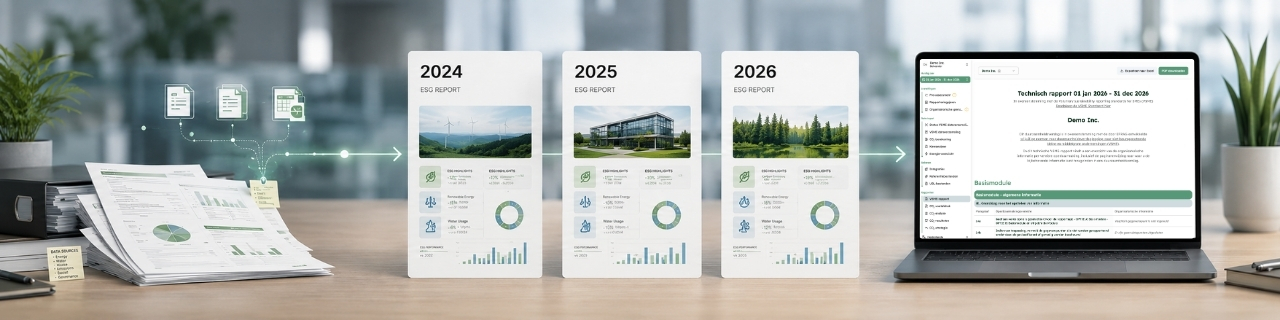
Instead of creating separate reports per entity and consolidating them afterwards, all entities work within one shared system.
One structure across all entities
All entities operate within the same:
- data definitions
- reporting structure
- methodology
New entities can be added without rebuilding the reporting process from scratch.
Central governance, local responsibility
The platform allows you to:
- assign roles and responsibilities per entity
- control access across teams
- combine local input with central oversight
Automatic consolidation
Instead of manual aggregation:
- data is consolidated automatically
- calculations remain consistent
- there is one single source of truth
Not at the end of the process - but from the start.
What this delivers in practice
For organisations with multiple entities, this changes the way reporting works:
- No rebuilding of reporting when a new entity joins
- No Excel models breaking under increased complexity
- No last-minute consolidation under time pressure
- One consistent report across the entire organisation
Most importantly:
A system that scales with your organisation, instead of becoming more fragile as it grows.
From coordination challenge to scalable system
Multi-entity ESG reporting is not just about collecting data.
It is about organising collaboration across the organisation.
By working in one shared system:
- reporting becomes manageable
- consistency is maintained
- growth is supported rather than slowed down
Not separate reports brought together at the end,
but one system used consistently across the organisation.
Who is this relevant for?
- Groups with multiple legal entities
- Organisations growing through acquisitions
- Companies operating across multiple locations or countries
- Finance, audit and compliance teams that require control and oversight
Make ESG reporting scalable as your organisation grows.
Set up your ESGpro account today, and see how the platform structures reporting across multiple entities.

Schrijf u in voor onze gratis online introductie en ontdek hoe ESGpro duurzaamheidsrapportering eenvoudiger, betrouwbaarder en slimmer maakt. We tonen stap voor stap hoe het platform werkt, wat u wint, en beantwoorden uw vragen live.